


Bappenas and the United Nations Launch Programme to Strengthen Climate-Resilient Food Systems
Press Release - Thu, 09 April 2026
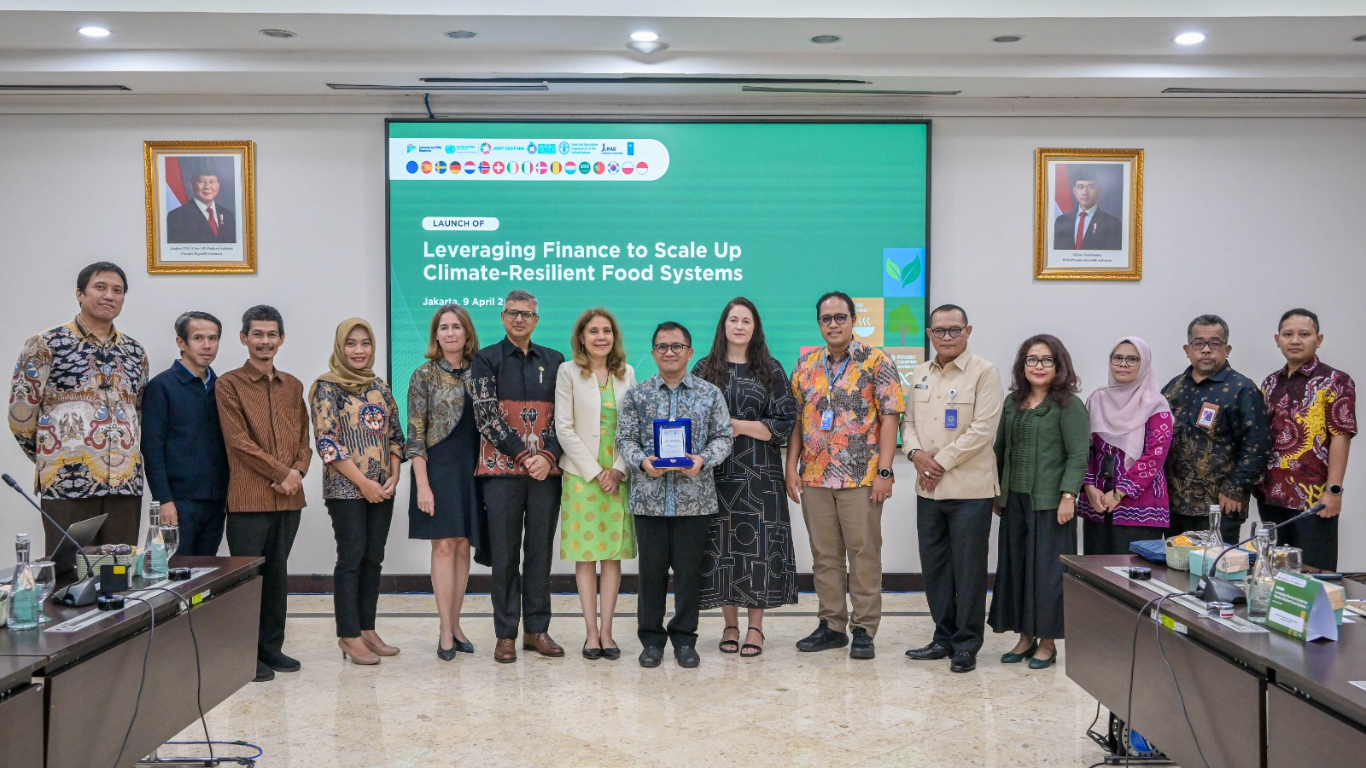
The Ministry of National Development Planning/Bappenas, together with the United Nations (UN), has launched a joint programme titled “Leveraging Finance to Scale Up Climate Resilient Food Systems” as part of efforts to accelerate the transformation of climate-resilient food systems in Indonesia.
Representing the Government of Indonesia, Deputy for Food, Natural Resources, and Environment at Bappenas, Leonardo A. A. Teguh Sambodo, emphasised that the agricultural sector is facing significant pressure due to increasingly complex global crises.
“We are currently facing three major threats at once, namely the global planetary crisis: climate change, pollution, and biodiversity loss. These threats directly affect national development and the future of our country, including the agricultural sector. Without action, we stand to lose nearly IDR 500 trillion from the agricultural sector alone,” he stated at a meeting held at the Bappenas Building in Jakarta on 9 April 2026.
Leonardo highlighted that the majority of Indonesian farmers are smallholders who remain vulnerable due to limited access to technology and financing.
“Facts on the ground show that around 90 per cent of Indonesia’s agriculture is supported by smallholder farmers. However, they often lack access to modern technology and sustainable practices, resulting in low productivity and heavy reliance on chemicals. Business-as-usual is no longer an option,” he stressed.
He further added that the Government of Indonesia has placed food systems transformation, climate resilience, and sustainable agriculture as top priorities in the 2025-2029 National Medium-Term Development Plan (RPJMN). The programme is expected to serve as a catalyst in bridging the financing gap while expanding the adoption of climate-smart agricultural technologies.
“This initiative represents both a milestone of hope and a blueprint for concrete action. We aim to mobilise innovative financing and bring resilient agricultural practices directly to smallholder farms, including through the integration of agricultural insurance and inclusive financing schemes,” he continued.
At the same meeting, the UN Resident Coordinator in Indonesia, Gita Sabharwal, underscored that cross-institutional collaboration is key to advancing sustainable food systems transformation.
“Smallholder farmers face two main constraints: access to technology and access to finance. This joint programme is designed to directly address both challenges through the deployment of climate-smart agricultural technologies, strengthening farmer insurance, and expanding inclusive financing,” she said.
The programme will integrate technical support from various UN agencies, including FAO and UNDP, while promoting public-private partnerships to expand access to financing and protection for farmers. In addition, it will utilise innovative financing instruments such as SDG bonds and blended finance to accelerate on-the-ground implementation.
Through an integrated approach, the programme aims to reach nearly half a million smallholder farmers, including women and young farmers, in key food production areas. Moving forward, the initiative is also expected to mobilise up to USD 205 million from public and private financing sources.
The launch of this programme reaffirms the strong commitment of the Government of Indonesia, together with international partners, to build a more resilient, inclusive, and sustainable food system, while contributing to global efforts to address climate change