


Bappenas Supports Strengthening Indonesia’s Food System through Sweet Potato Research Centre
Prime News - Tue, 09 September 2025
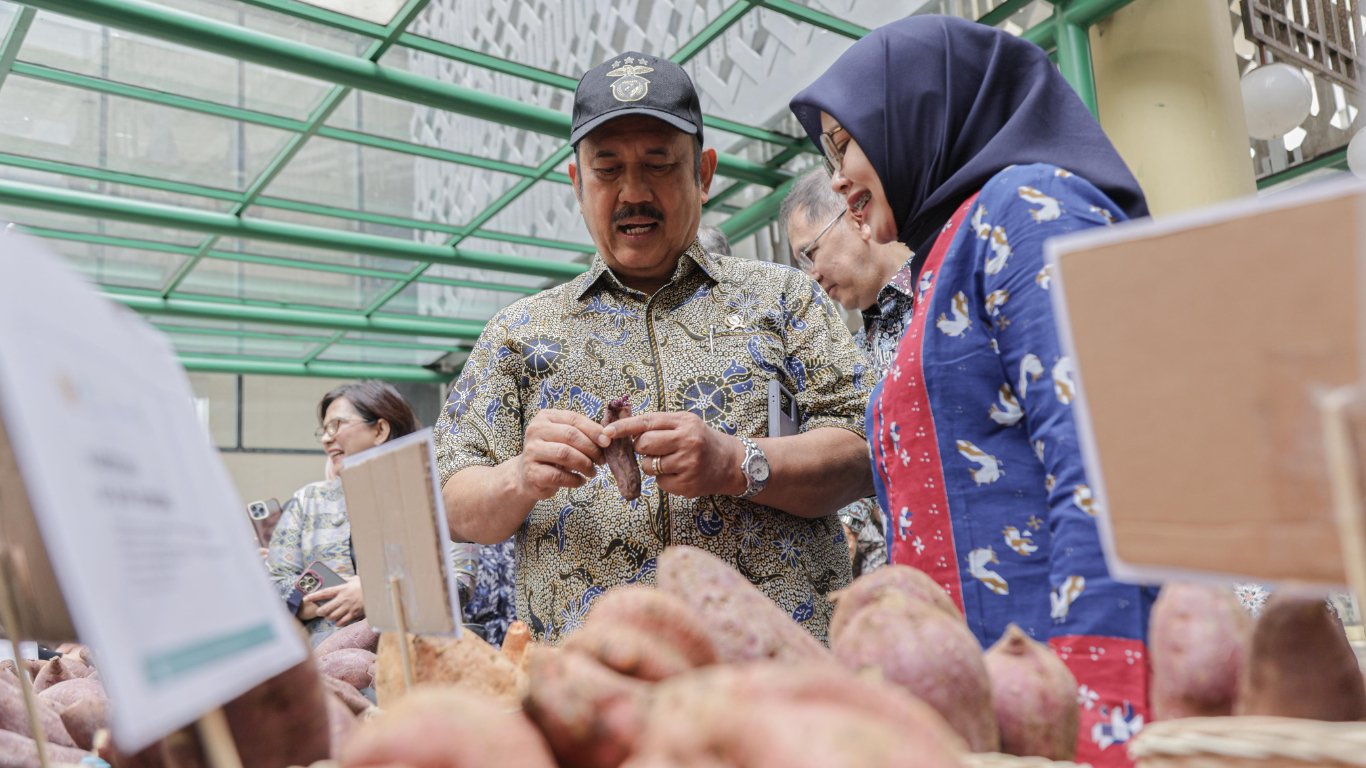
SUMEDANG – The Minister for National Development Planning/Head of Bappenas, Rachmat Pambudy, stated that the development of sweet potatoes is a strategic step outlined in the 2025-2029 National Medium-Term Development Plan (RPJMN), particularly under the priority programme for developing local and plant-based food.
“Sweet potatoes have high added-value potential, making them worthy of being promoted as a leading commodity not only to support food security but also to strengthen the transformation of the national food system,” explained Minister Rachmat during the inauguration of the Padjadjaran Center of Sweet Potato Research and Innovation Excellence (PRAISE) at Universitas Padjadjaran, Jatinangor, on Tuesday (9 September).
The event was also attended by Deputy Minister for National Development Planning/Deputy Head of Bappenas, Febrian Alphyanto Ruddyard; FAO Representative for Indonesia and Timor-Leste, Rajendra Aryal; as well as university leaders and the civitas academica of Universitas Padjadjaran.
Data from the National Food Agency show that the Indonesian diet is still dominated by rice. In 2024, sweet potato consumption was only 3.1 kg per capita per year, far below rice consumption, which reached 92.1 kg per capita per year. Yet sweet potatoes are rich in fibre, complex carbohydrates, and have a low glycaemic index that is beneficial for health. Meanwhile, according to Ministry of Agriculture data, national sweet potato production in 2024 amounted to only 1.38 million tonnes and has been declining, indicating the need for strengthening from production to consumption.
“Sweet potatoes are one of the carbohydrate sources with extraordinary potential. The step we are taking today marks the beginning of establishing a national sweet potato centre that can eventually develop into an international hub. This is Indonesia’s food revolution, Indonesia’s agricultural revolution, which can contribute to the world. It is time to build a new civilisation through a food revolution born from the work of Indonesian experts, based on Indonesia’s native genetic resources,” said Minister Rachmat.
The minister also delivered a public lecture as part of Universitas Padjadjaran’s Science Talk series, entitled “Sweet Potato: Science Bridging to Policy”, which discussed the strategic role of food diversification policies in supporting national sovereignty.
“Sweet potatoes are not merely a genetic resource, but with research and development by our scientists, they can provide significant added value. Sweet potato-based agriculture can strengthen national food security while also contributing globally, and I am grateful to be part of this great effort,” concluded Minister Rachmat.