

Bappenas and World Bank EDS16 Discuss Strengthening Industrial Downstreaming at IMF–WBG Meetings
Development News - Thu, 16 April 2026
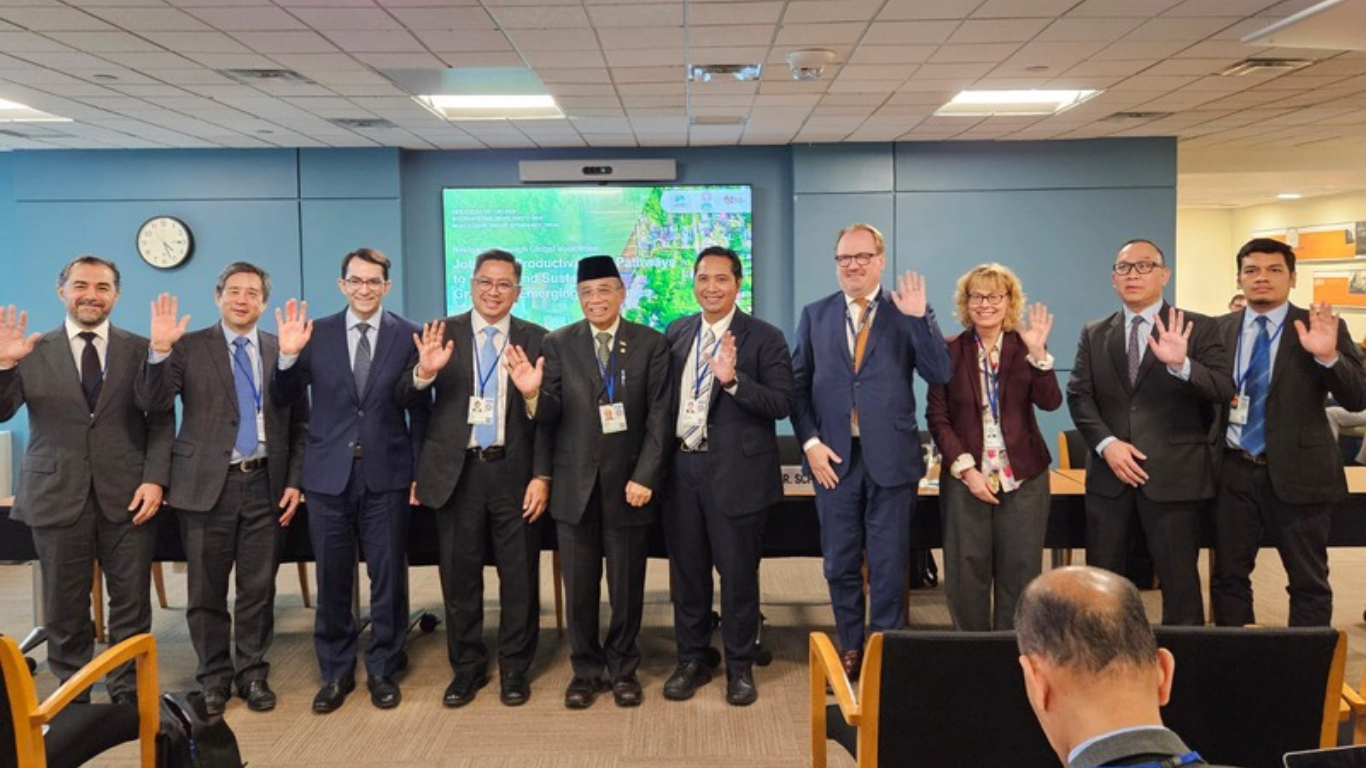
The Ministry of National Development Planning/Bappenas, together with the Office of the Executive Director for the Southeast Asia Voting Group (EDS16) of the World Bank Group, held a side event entitled “Navigating Through Global Volatilities: Job and Productivity-led Pathways to Strong and Sustainable Growth in Emerging Economies” as part of the International Monetary Fund–World Bank Group Spring Meetings (IMF–WBG) in Washington, D.C., United States, from 13–18 April 2026.
The forum served as a platform for Indonesia to voice the importance of downstream industrial development and productivity enhancement as strategies for developing countries in responding to global economic and political uncertainty.
“Economic growth in developing countries, including Indonesia, has thus far been driven more by the accumulation of capital and labour than by innovation or technological efficiency,” stated Deputy for Macroeconomic Development Planning at the Ministry of National Development Planning/Bappenas Eka Chandra Buana on Thursday, 16 April.
Discussions during the side event highlighted the challenges faced by developing countries in maintaining strong and stable economic growth amid global volatility, ranging from geopolitical tensions, trade fragmentation, and financial tightening to the impacts of climate change. Indonesia underscored the importance of structural transformation through shifting from raw material exports towards high value-added industries based on natural resources, technological mastery, and strengthened human resource capacity.
The dialogue, attended by experts from the World Bank Group, the Asian Development Bank (ADB), the Organisation for Economic Co-operation and Development (OECD), and academia, offered various strategic perspectives, including responses to global employment challenges, the importance of digitalisation, strengthening downstream industrialisation, and enhancing the role of the diaspora in supporting education.
Director of Macroeconomic Planning and Development Modelling at the Ministry of National Development Planning/Bappenas Ibnu Yahya stated that businesses in Indonesia still face gaps in access to financing and technological capabilities, particularly among small-scale enterprises that have emerged as a result of job losses in the formal sector.
The event produced four key messages for developing countries in navigating current global uncertainty. First, the importance of transforming towards high value-added industries. Second, the need to adopt a holistic development approach. Third, the strengthening of collaboration with international institutions such as the World Bank, OECD, and ADB to enhance knowledge capacity and determine development financing instruments. Finally, the importance of creating a development planning ecosystem supported by think tanks and improvements in the quality of education related to development planning.
“To escape the middle-income trap, a holistic approach is required, where macroeconomic stability must go hand in hand with targeted industrial policies, sustainable skills development, and dynamic business growth,” Deputy Chandra concluded.