

Bappenas Encourages Strengthening of the Sustainable Palm Oil Agribusiness Ecosystem
Prime News - Tue, 19 May 2026
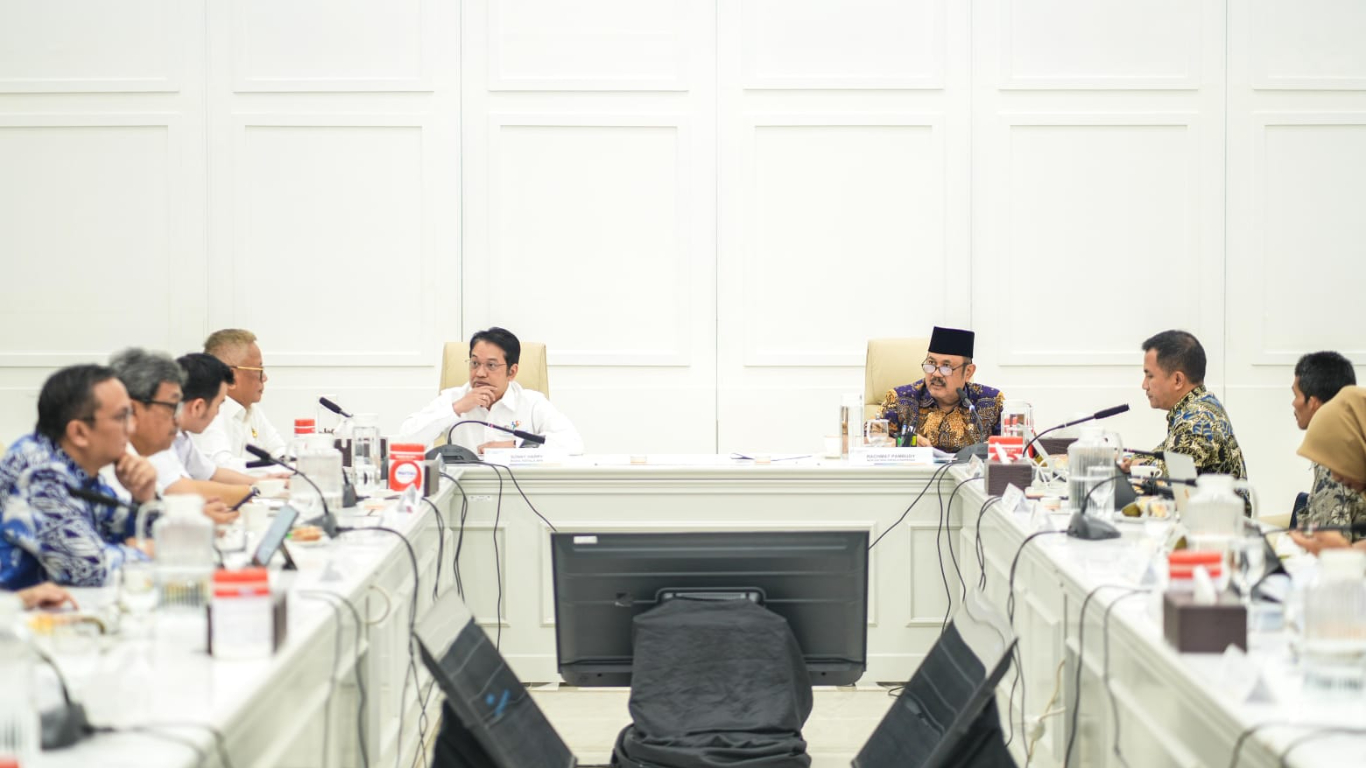
The Minister of National Development Planning/Head of Bappenas Rachmat Pambudy received a visit from President Director of PT Agrinas Palma Nusantara (Persero) Mohammad Abdul Ghani, which was also attended by Deputy Head of Statistics Indonesia (BPS) Sonny Harry Budiutomo Harmadi, at the Bappenas Office in Jakarta on Tuesday, 19 May.
The meeting discussed the restructuring of PT Agrinas Palma Nusantara (Persero), which is directed towards improving sustainable palm oil plantation governance while supporting the enhancement of public welfare.
As a follow-up to the President’s directive regarding the National Strategic Project (PSN) on the Acceleration of Governance Strengthening, Downstream Development, and the Palm Oil Agribusiness Ecosystem, Minister Rachmat Pambudy emphasised the importance of synergy between strengthening the upstream (on-farm) and downstream (off-farm) sectors.
“The President’s directive is extremely important and must be followed up immediately. We share the same emphasis. PT Agrinas Palma Nusantara is more focused on the on-farm sector, while the Ministry of National Development Planning/Bappenas focuses on downstream or off-farm development policies. However, off-farm development cannot proceed without support from the on-farm sector. Therefore, we must work in unison,” he stated.
Recorded palm oil plantation land currently covers approximately 17 million hectares, while field estimates suggest the actual figure could be nearly double that amount. Therefore, the role of Statistics Indonesia (BPS) is considered essential in preparing a single national palm oil data system to ensure data accuracy as the basis for policy formulation. Strengthening partnership principles with palm oil smallholders will also be pursued to guarantee improved farmer welfare while encouraging national palm oil productivity. In addition, a cooperative-based development model is viewed as strategic in ensuring that the added value of the palm oil industry can be directly enjoyed by smallholder farmers rather than relying solely on the price of fresh fruit bunches (FFB).
Furthermore, Minister Rachmat stressed the importance of implementing sustainability principles through the development of low-emission and energy-efficient palm oil processing systems that remain economically competitive. The government will formulate a broad framework for strengthening palm oil governance and the agribusiness ecosystem based on the Sustainable Development Goals (SDGs).
The management of palm oil by PT Agrinas Palma Nusantara (Persero) is expected to contribute as broadly as possible to the achievement of SDGs 1 through 17. In this regard, strengthening palm oil governance is expected not only to safeguard the sustainability of the national palm oil industry, but also to become an important part of achieving inclusive and sustainable development that delivers broad benefits to society