

Bappenas and Pelindo Discuss Development of Dumai Trans-Shipment Hub to Support National Logistics and Connectivity Systems
Prime News - Mon, 27 April 2026
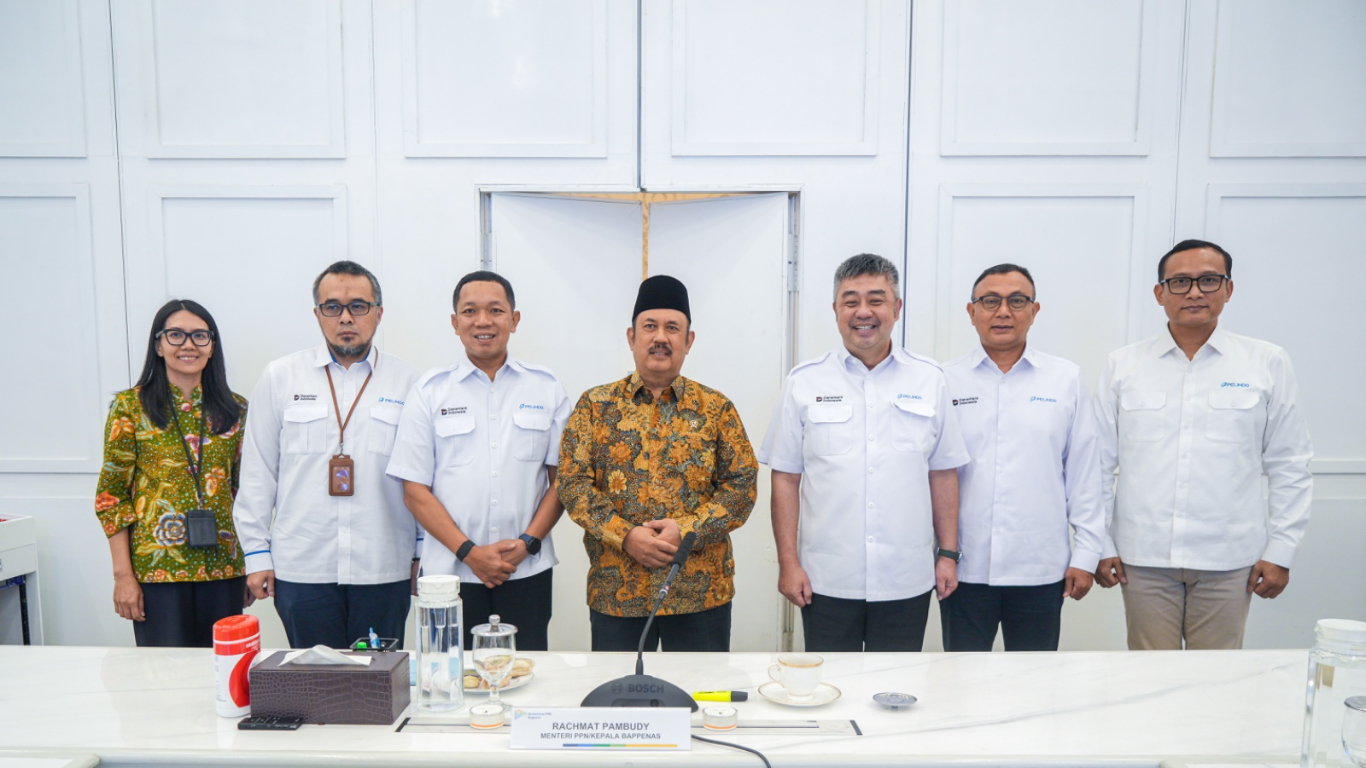
The Minister for National Development Planning/Head of Bappenas Rachmat Pambudy received President Director of PT Pelabuhan Indonesia (Pelindo) Achmad Muchtasyar to discuss plans for the development of the Dumai Transshipment Hub as part of efforts to strengthen the national logistics system and Indonesia’s position within global shipping routes, at the Bappenas Office, Jakarta, on Monday, 27 April 2026.
During the meeting, Minister Rachmat Pambudy emphasised the strategic importance of ports for Indonesia as an archipelagic nation. “Indonesia is a country with numerous straits. In this context, ports serve as a primary component in safeguarding sovereignty while connecting regions,” Minister Rachmat Pambudy stated.
As one of the world’s busiest global maritime routes, the Strait of Malacca presents a strategic opportunity for Indonesia to develop transshipment ports. However, Indonesia currently still functions primarily as a gateway port and has yet to become part of the global hub network, which continues to be dominated by ports in neighbouring countries.
Pelindo presented its phased development plan for the Dumai Transshipment Hub, with initial operational targets set for 2030. Dumai is considered to have strong potential for development as a hub, supported by land availability and a strategic geographical position.
Regarding the proposal to designate the Dumai Transshipment Hub as a National Strategic Project (PSN), Minister Rachmat Pambudy stated that the Ministry of National Development Planning/Bappenas will assess its alignment with the 2025–2029 National Medium-Term Development Plan (RPJMN), including compliance with PSN criteria as stipulated under Minister of National Development Planning/Head of Bappenas Regulation No. 4 of 2025.
In addition, cross-ministerial and inter-agency coordination will be required to establish differentiated functions among candidate ports such as Dumai, Batam, and Kuala Tanjung, in order to avoid potential duplication of roles and overinvestment.
The meeting also covered plans for the development of the Maritime Connectivity Hub platform (Adhara) to support stronger governance under the One Data Indonesia framework, as well as the development of the Bali Maritime Tourism Hub (BMTH).
Concluding the discussion, Minister Rachmat Pambudy underscored the importance of building an integrated national logistics ecosystem. “Our connectivity lies in our ports. When the idea of a national logistics ecosystem was introduced, it was indeed something that needed to be realised. The challenge is how to build a national logistics ecosystem in such a way that logistics is not focused solely on transportation or ports, nor merely on reducing transport costs, but is also capable of safeguarding national sovereignty. Therefore, a national logistics ecosystem must be established, and that is why further discussion is necessary,” the Minister concluded