


Bappenas Promotes Grand Strategy for the Development of the National Semiconductor Industry
Prime News - Thu, 12 March 2026
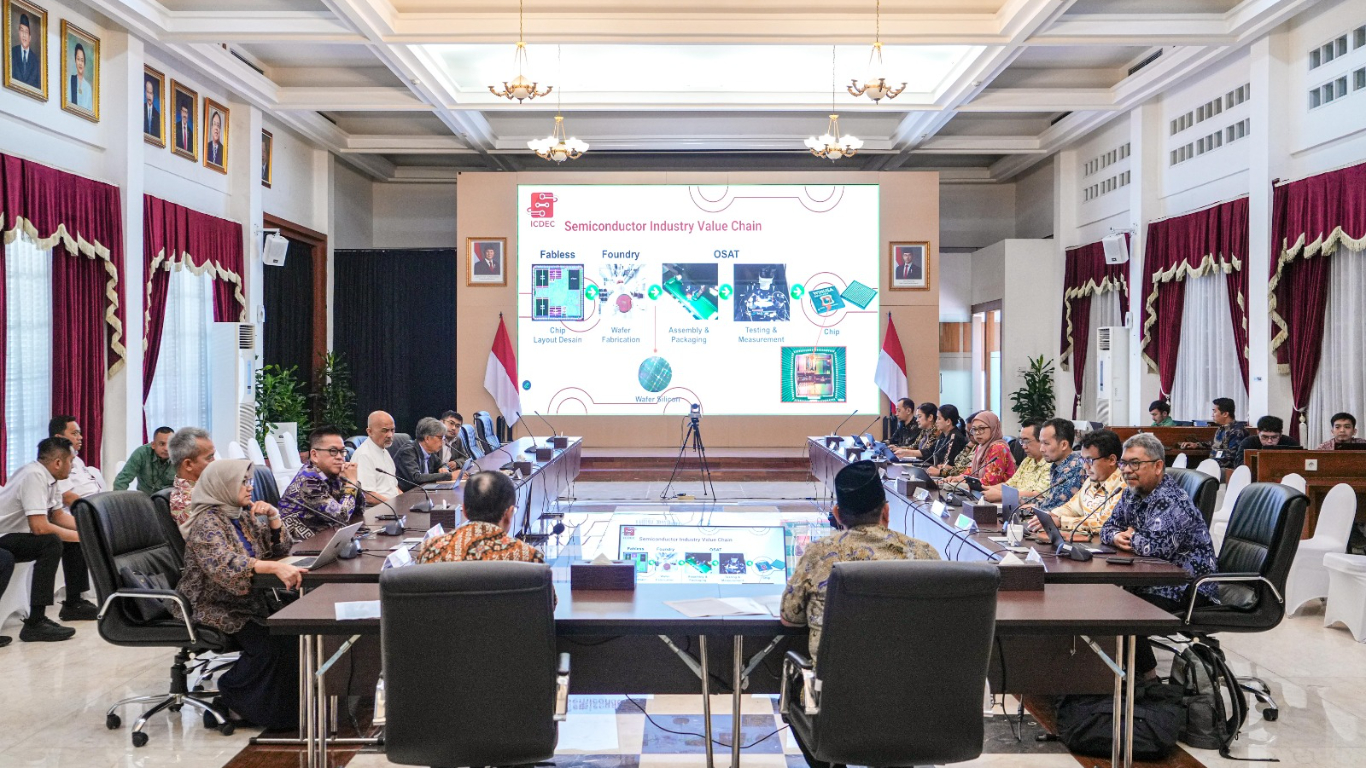
JAKARTA – The Minister for National Development Planning/Head of Bappenas Rachmat Pambudy received a delegation from the Indonesian Chip Design Collaborative Center (ICDEC), led by ICDEC Chairman at the Bandung Institute of Technology (ITB) Trio Adiono, at the Bappenas Building, Jakarta, on 12 March 2026.
The meeting discussed strengthening strategies for the development of Indonesia’s national semiconductor industry through collaboration between the government, universities, and industry.
On the occasion, Minister Rachmat emphasised that the development of the semiconductor industry requires a comprehensive long-term strategy to enable Indonesia to integrate into the global value chain of the industry.
“What we need is a grand strategy, not merely a roadmap. The grand strategy must answer how Indonesia can enter and integrate into the semiconductor industry value chain. This is not only about short-term planning, but about how, in the next 20 years, we will have a clear position, from design and layout to the operational capabilities of the industry,” he said.
According to him, the semiconductor industry has characteristics where complex technological components generate very high added value. Therefore, Indonesia must prepare a strategy to enter segments that offer greater economic value.
“Among the many components in a product, it may be that 90 per cent are relatively simple, yet the remaining 10 per cent complex components account for the majority of the cost and technological value. That is where our challenge lies. If we want to enter this industry, we must be willing to tackle the most complex parts,” he explained.
ICDEC Chairman at ITB, Trio Adiono, stated that ICDEC is a collaborative organisation supported by various universities and industry partners to strengthen Indonesia’s semiconductor ecosystem.
“ICDEC is a local organisation supported by 18 universities from various regions across Indonesia, including institutions in Sumatra, Java, and Sulawesi. In addition, we also collaborate with five industries. Our focus is on building talent, developing the industrial ecosystem, and encouraging innovation in the semiconductor field,” said Trio.
He explained that ICDEC has proposed a number of programmes for the development of the semiconductor industry, including applied research, product development, and strengthening chip design capacity.
“We have proposed programmes for applied research and semiconductor product development, some of which have already been included in the national development bluebook. Our vision is to build talent, develop the industrial ecosystem, and strengthen innovation so that Indonesia can build strong capacity in the semiconductor sector,” he explained.
In addition, ICDEC has also undertaken various initiatives to develop human resources to support the industry, including sending 450 Indonesian talents to Taiwan over the past two years to work and learn in semiconductor companies in order to strengthen Indonesia’s talent capabilities.
Closing the meeting, Minister Rachmat stressed that the development of Indonesia’s semiconductor industry must be carried out gradually with a strong foundation, including strengthening human resources, research, and the industrial ecosystem.
“This process cannot be completed in a short time. Do not expect it to be finished tomorrow. What we are building is a long-term foundation so that Indonesia can truly rebuild high-technology industries such as semiconductors in a sustainable manner,” he concluded